
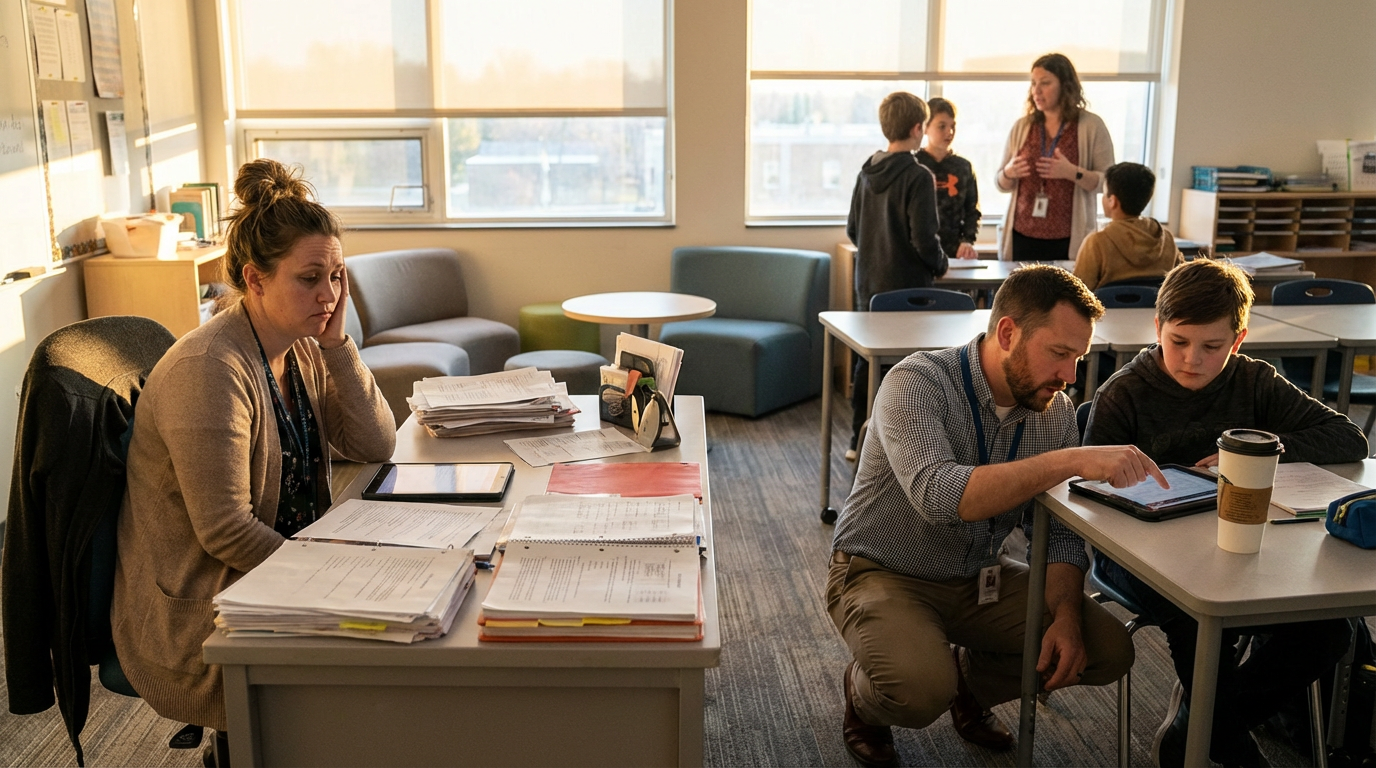
New research from UNSW shows just how stretched Australian teachers have become.
Ninety per cent are experiencing severe stress. Nearly seventy per cent say their workload is unmanageable. Rates of depression and anxiety are more than double the national average. This isn't just a wellbeing issue. It's a workforce crisis.
Teachers aren't leaving because they don't care about students. They're leaving because admin, compliance, reporting, and data tasks are crowding out the work they actually trained for: teaching.
Link Read more: 90% of Australian teachers severely stressed
AI can help, but only if it's deployed properly
A lot of current discussion focuses on AI as an assistant. Tools that help draft plans, mark work, or generate resources. These can help, but they still rely on teachers to initiate, supervise, and clean up the output.
The bigger opportunity is AI as embedded agents.
That means systems designed so the work doesn't land on teachers in the first place. Attendance summaries, reporting, evidence collation, differentiation variants, compliance paperwork. If a policy adds a task, it should come with an automated way to remove or absorb that task.
Any reform that increases teacher workload without removing something else is not serious reform.
Even then, AI is only part of the solution. The core challenge remains reducing pressure so teachers can focus on students.
Teachers must stay at the centre of AI for schools
That point comes through strongly in recent guidance from UNESCO.
AI can help with planning, marking, and personalising learning. But it cannot replace empathy, creativity, ethical judgement, or the sense of belonging teachers create every day.
UNESCO also highlights a stark reality. The world will need 44 million more teachers by 2030. At the same time, AI is entering classrooms everywhere. The task isn't choosing between teachers or technology. It's making sure they work together.
Link Read more: Teachers cannot be coded (UNESCO)
Public trust in Australia is fragile
The latest Education Monitor from Ipsos shows an interesting contrast.
Australians rate their schools highly compared to most countries. But when it comes to AI for schools, we're among the most cautious.
Out of 30 countries, Australians are the fourth most likely to support a ban on tools like ChatGPT in schools. Almost half think AI shouldn't be used at all. Twenty-nine per cent see generative AI as one of the biggest challenges in education, on par with lack of funding.
Other countries are pressing ahead, experimenting, testing, and learning. If Australia freezes, the gap will grow.
Link Download: Education Monitor AU country 2025 (Ipsos)
Guardrails matter and they need to be explicit
Common Sense Media recently assessed AI teacher assistants and rated them moderate risk.
Their conclusion feels right to me. These tools can save time and support teachers, but only with guardrails.
What works:
- Adapting existing materials rather than replacing teacher expertise
- Handling repetitive tasks
- Saving time for direct student work
- Using curriculum and lesson context as input
The risks:
- AI doesn't understand students, classrooms, or culture
- Bias and inaccuracies can slip through
- Over-automation can bypass professional judgement
- New teachers may lean too heavily on tools they don't yet know how to review
Clear policies, training, transparency with families, and mandatory human review are not optional extras.
Link Read the AI ratings: AI teacher assistants (Common Sense Media)
There are positive signs when it's done well
Queensland's announcement of Corella, an AI tool rolling out to all state high schools, is one example of a system trying to get this balance right. Early trials show time savings for teachers and study support for students, without replacing thinking.
South Australia's use of EdChat shows the same pattern. AI in the loop, humans still at the centre. Thousands of hours given back, not taken away.
Link Read more: How students and staff are embracing AI in teaching and learning
My takeaway
AI in schools is no longer hypothetical. It's already here.
The real question is whether AI for schools:
- reduces teacher workload or quietly adds to it
- strengthens professional judgement or bypasses it
- supports equity or widens gaps
- earns trust or erodes it
Teachers are under extraordinary pressure. If AI doesn't meaningfully remove load, it will fail them. If it does, it might help stabilise a workforce that is close to breaking.
AI for schools should amplify teachers, not exhaust them.